
The Best Truck Gun: What Actually Works (And What Doesn’t)
Every truck gun article eventually gets around to saying the same thing: “it depends on your situation.” And that’s true. But it’s also a cop-out that avoids the harder, more useful question—what does a well-thought-out truck gun setup actually look like when you commit to getting it right?
We spend a lot of time thinking about this. Our products live in this space. And after looking at how real people in real situations actually use vehicle-stored firearms—ranchers, backcountry hunters, long-haul drivers, rural residents—a clear picture of what the best truck gun setup looks like starts to emerge. This is that picture.
What Makes a Truck Gun Different From Every Other Firearm You Own
Your truck gun isn’t your home defense gun. It isn’t your range gun. It isn’t your competition setup. It fills a specific role that none of those other firearms cover: accessible, vehicle-stored firepower that can handle situations your EDC pistol can’t.
That role comes with specific constraints that shape every decision downstream:
It has to fit—and not just in storage. This sounds obvious until you start measuring. A standard AR-15 with a 16″ barrel is 35+ inches long with the stock extended. That doesn’t live in a center console, under a seat, or in any discreet vehicle storage. But the problem isn’t just where it sits when you’re not using it—it’s what happens when you actually need it. A full-length rifle inside a truck cab is unwieldy to the point of being dangerous. You’re fighting the headliner, the door frame, the steering wheel, and your own seatbelt just to get the gun oriented. If you’ve ever tried to maneuver a 35″+ rifle in a cab under any kind of stress, you understand immediately why length isn’t just a storage problem—it’s a deployment problem. The best truck gun configurations are built around a realistic folded or stored length—something in the 20-22″ range—precisely because that size works in the truck, not just next to it.
It has to be ready. A truck gun you have to assemble under stress isn’t a truck gun—it’s a parts kit. Whatever you choose needs to go from stored to deployed in seconds, not minutes. This is where folding mechanisms earn their money, and where the difference between a well-engineered fold and an adapter-based workaround starts to matter.
It has to be reliable without attention. Your truck gun might sit for weeks between range trips. It’ll see temperature swings, vibration, dust, and the occasional neglect. Unlike your competition gun that gets cleaned after every match, your truck gun need
s to work when you’ve half-forgotten it exists.
It has to be capable enough to matter. This is the one most people underweight. There’s a real difference between a solution that technically fills the “truck gun” checkbox and one that’s actually capable across the range of scenarios you might face—extended distances, vehicle threats, large predators in big country. Caliber selection isn’t just a technical choice; it’s a practical one.
Caliber: The Decision That Shapes Everything Else
The caliber question for truck guns usually comes down to three realistic options: pistol caliber, 5.56 NATO, or larger rifle cartridges. Each makes sense for a different use case.
Pistol caliber carbines (9mm, .40, .45) offer real advantages: manageable noise in a vehicle context, lower recoil for faster follow-up shots, and ammunition commonality with a sidearm. For urban or suburban use cases where distances are short and the threat profile is human, a pistol-caliber carbine is a legitimate choice. The Shield Arms SA-9 is exactly this kind of build—9mm, folding lower receiver, genuinely compact, and capable for close-range work. If your truck gun scenario is primarily about a step-up from your EDC at shorter distances, a folding PCC like the SA-9 is worth serious consideration.
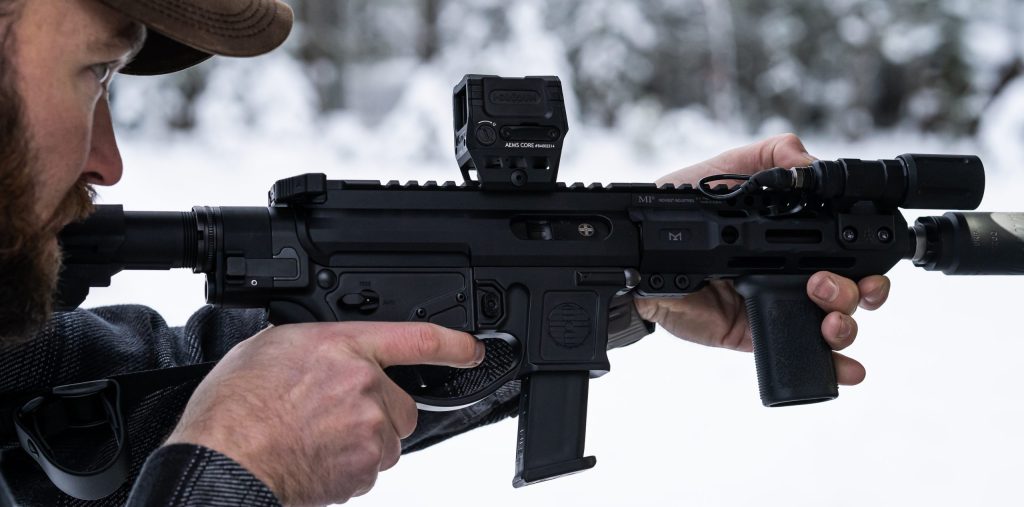
5.56 NATO is where most serious truck gun builds end up, and for good reason. At practical vehicle engagement distances, 5.56 from a short barrel (10.5″ to 14.5″) delivers real terminal performance that pistol calibers can’t match. It reaches farther. It hits harder. And in a rural context—where threats might be two-legged or four-legged, close or at distance—that matters. The SA-15 Folding 11.5″ Pro Pistol is what an honest 5.56 truck gun build looks like: 11.5″ barrel, folded to 20.5″ total length, under 6 lbs, built on a folding lower that doesn’t add weight or length through adapter engineering.
Larger rifle cartridges (.308, 6.5 Creedmoor) make sense for specific contexts—ranch use where you might need to engage threats at 300+ yards, or predator control in genuinely open country. The tradeoff is size, weight, and noise. For most truck gun use cases, they’re more than necessary.
The honest answer for most people in most situations: if you’re primarily in urban or suburban environments, a pistol-caliber folder is practical and capable. If you’re covering rural ground, hunting country, or want a single solution that handles the full threat spectrum, 5.56 from a compact folding platform is the best truck gun caliber for the job.
Barrel Length: Short Enough to Matter, Long Enough to Work
Barrel length on a truck gun is a real engineering tradeoff, not just an aesthetic choice.
Go too short—under 10 inches—and you start fighting the carbine gas system. Reliability becomes more finicky. Velocity drops enough to affect terminal performance with some loads. The blast and flash signature increases substantially, which matters if you’re shooting in or around a vehicle.
Go too long—16 inches—and you’ve given up the size advantage that makes a truck gun viable in the first place. A 16″ barrel with a standard stock puts you well north of 35″ overall, which isn’t just hard to store—it’s nearly impossible to use effectively inside a vehicle cab. You can’t bring a gun that length to bear from a seated position without it catching on the dash, the door, the ceiling, or the seat back behind you. In a real scenario, that matters enormously.
The sweet spot for most 5.56 truck gun builds is 11.5″ to 13.9″. That range keeps you in carbine-gas territory (more reliable than pistol-length gas on a short barrel), maintains meaningful velocity, and keeps the overall package compact. The SA-15 Pro Pistol’s 11.5″ 4150 CMV barrel with a carbine-length gas system and .070″ gas port sits right in this range—the result of actually thinking through the tradeoffs rather than splitting the difference arbitrarily.
An adjustable gas block, like the one spec’d on the SA-15, is worth having on any serious truck gun build. It lets you tune for suppressor use, adjust for different ammunition loads, and keep the gun running when conditions aren’t ideal.
The Folding Question: Why Most Folding AR Builds Get It Wrong
If you’ve looked at folding AR builds before, you’ve probably seen the standard approach: take a normal AR lower, add a folding adapter between the lower and buffer tube, and call it done. This works, technically. But it comes with real costs.
A folding adapter adds length—typically around an inch—to the receiver package. It adds weight. It requires a modified or captured carrier because the BCG can’t cycle when folded. And it introduces an additional mechanical interface that can come loose, wear, or fail.
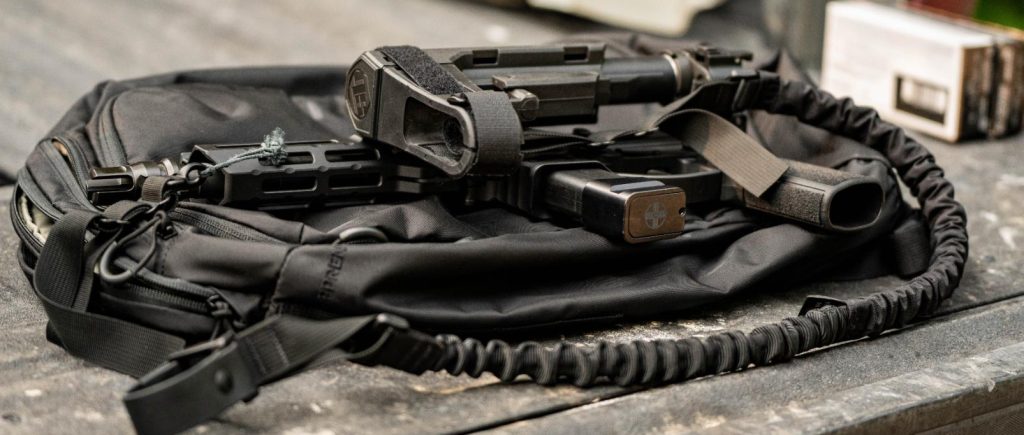
The better approach is what Shield Arms spent years engineering into their Folding Lower Receiver: a folding mechanism built directly into the lower receiver itself. No adapter, no added length, no carrier modification, no extra failure points. The SA-15 folds at the lower receiver, collapses to 20.5″ total, and deploys instantly—the same motion every time, with no extra steps and no adapter engineering to go wrong.
That’s the difference between solving the truck gun size problem and working around it.
No Tax Stamp Cost: The AR Pistol Advantage (And the SBR Option)
This one is worth saying plainly, because it’s a real consideration that shapes how you build.
The SBR route — a short barrel under 16″ with a traditional stock — used to come with a $200 tax stamp cost on top of the NFA process. That $200 fee is now gone. If you want a traditional stock on your short-barreled truck gun, you can pursue an SBR stamp for free. What hasn’t changed is the process itself: ATF wait times, registration, and the requirement to notify or get approval before transporting across state lines. For a truck gun that travels with you, that interstate friction is worth factoring in.
The AR pistol route skips the process entirely. The SA-15 11.5″ Pro Pistol ships configured with an SB Tactical SBA3 brace — no stamp, no wait, no registration, no compliance steps when you cross state lines. Transfer through your FFL and you’re running. Same 11.5″ barrel, same 5.56 NATO capability, none of the NFA overhead.
If you want a traditional stock and don’t mind the paperwork, the free stamp makes the SBR route more accessible than ever. If you want the truck gun in your hands immediately with no process attached, the AR pistol is the faster, simpler path — and it’s how the SA-15 is built from the factory for exactly that reason.
The Complete Best Truck Gun Setup
A truck gun is a system. The firearm is the center of it, but the gear around it determines whether the whole thing actually works.
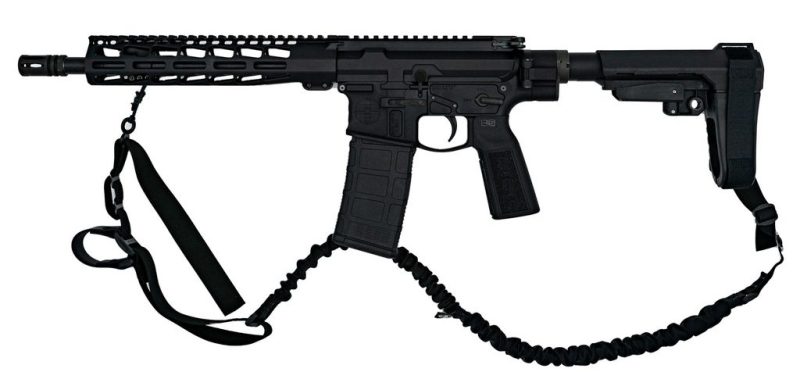
The Firearm: A compact, folding 5.56 platform in the 11.5″–13.9″ barrel range. Built on quality components—7075-T6 billet receivers, MPI-inspected BCG, adjustable gas block. The SA-15 11.5″ Pro Pistol is the benchmark here. Everything else is either a compromise in different directions or a legitimate alternative for a different use case (like the SA-9 if you’re prioritizing pistol-caliber compactness).
Storage: A quality steel lockbox, cable or bracket-mounted to your vehicle. At 20.5″ folded, the SA-15 fits in under-seat storage options that a standard AR can’t touch. The lockbox keeps it secured, legal, and inaccessible to anyone who shouldn’t have it. Measure your storage space before you buy—the folded dimension is what matters, and it varies significantly between platforms.
Go-Bag: The Bang Bag is what lives alongside the gun — extra magazines, medical supplies, a light, and whatever else belongs in a compact grab-and-go setup. Laser-cut MOLLE, magnetic closure, made in Montana. It’s not a gun bag; it’s the support kit that makes the whole system actually useful when you grab it and go.
Sling: Once the gun is out of the truck, a good sling is the difference between controlled movement and fumbling with a loose rifle. The Mountain Partisan Sling runs a two-stage progressive tension system with a quick-adjust and a high-temp Kevlar loop. Designed by a former Green Beret. It’s what we run on our folding platforms because it handles the transitions that matter in a vehicle context.
Optic: For most truck gun scenarios, a compact red dot covers 0–200 yards cleanly and keeps the package light and fast to deploy. If your use case extends to distance—open country, ranch work, hunting scenarios—a 1-4x or 1-6x LPVO adds meaningful capability without breaking the compact profile.
Magazines: Keep a handful of loaded PMAGs with the gun. 30-rounders store efficiently alongside a folded platform. If you’re running any Shield Arms PMAG extensions, the +5 adds capacity without changing the storage footprint meaningfully.
Common Truck Gun Mistakes (And How to Avoid Them)
Grabbing a full-size AR from the safe and calling it a truck gun. A 16″ AR with a full stock is a great rifle. It’s a terrible truck gun. Beyond the storage problem, it simply doesn’t work in the confined geometry of a vehicle cab—the length fights you at every step. If this is your current truck gun plan, it’s worth revisiting before you need to find out the hard way.
Underestimating the size problem. Measure your actual storage space before you buy anything. A truck gun that doesn’t fit your truck isn’t a truck gun—it’s a frustration.
Skipping the break-in and function testing. Your truck gun needs to have rounds through it before it goes in the vehicle. You need to know it runs your specific ammunition reliably. Don’t let it sit untested.
Neglecting the storage solution. A loose firearm bouncing around in your truck is a safety issue, a theft risk, and in many states a legal one. A quality lockbox is part of the build, not optional.
Picking caliber for the wrong reasons. Smaller isn’t always better, and bigger isn’t always more capable. Match the caliber to your realistic use case, not to what sounds impressive at the range.
The Bottom Line
The best truck gun is the one that actually fits your truck, deploys when you need it, hits hard enough to matter, and holds up through neglect and weather without flinching. That’s a specific set of requirements—and it points toward a compact, folding 5.56 platform as the answer for most people in most situations.
What it looks like in practice: a quality folding build in the 11.5″–13.9″ barrel range, stored in a secure lockbox, ready to deploy in seconds, and paired with a good sling and carry bag for when it needs to move. That’s the setup. Build it once, build it right, and don’t think about it again until you need it.
Shop SA-15 Folding Pistols | Shop SA-9 Folding PCC | Shop Truck Gun Accessories
Best Truck Gun FAQ
What is a truck gun?
A truck gun is a firearm stored in a vehicle for use in situations where your EDC handgun isn’t sufficient—extended distances, vehicle threats, dangerous animals, or remote locations far from help. The best truck gun setups balance compact storage, fast deployment, and meaningful capability.
What caliber is best for a truck gun?
For most use cases, 5.56 NATO from a compact barrel (11.5″–13.9″) is the best truck gun caliber. It reaches farther and hits harder than pistol calibers while remaining controllable and compact. Pistol-caliber carbines like the SA-9 in 9mm are a legitimate alternative for primarily urban or close-range scenarios.
What’s the ideal barrel length for a truck gun?
11.5″ to 13.9″ hits the practical sweet spot for a 5.56 truck gun. Short enough to fold down to a storable length, long enough to run a carbine-gas system reliably and maintain meaningful velocity.
How should I store a truck gun in my vehicle?
In a quality steel lockbox, secured to the vehicle by cable or bracket mount. Follow all applicable state and local laws for transport and storage. Always keep it locked when unattended.
Is an AR pistol or SBR better as a truck gun?
Both are legitimate options, and the right choice depends on how much process you want to deal with.
The good news for SBR fans: the tax stamp is now free. The $200 fee that used to be the primary deterrent is gone. If you want a traditional stock on your short-barreled build, you can pursue the SBR route without the cost. What you can’t avoid is the process — ATF wait times, registration, and the requirement to get prior approval before transporting across state lines. For a truck gun that might travel with you regularly, that interstate compliance piece is worth thinking through carefully.
The AR pistol route — which is how the SA-15 11.5″ Pro Pistol ships, configured with an SB Tactical SBA3 brace — skips the process entirely. No wait, no registration, no permission slip to cross state lines. You transfer through your FFL and you’re done. Same short barrel, same capability, none of the NFA friction.
If you’re comfortable with the SBR process and want a traditional stock, the free stamp makes it more accessible than ever. If you’d rather skip the paperwork altogether and get your truck gun running immediately, the AR pistol configuration is the faster path.
What’s the difference between a folding adapter and a purpose-built folding lower?
A folding adapter bolts between the lower receiver and buffer tube, adding length, weight, and a modified carrier requirement. A purpose-built folding lower like the Shield Arms FLR integrates the hinge directly into the receiver—no adapter, no added length, no carrier modification, no extra failure points.